When the opening scenes of a movie are played on the right surround sound setup in the dark in a space that doesn’t give me the feeling of a plane, there’s a certain magic that happens. It’s not just watching a film any longer! It’s an experience, that is, it’s a trip to another place altogether, an experience that takes you out of your normal world.
That experience was used to take a bus to the movies. Now, it can reside in your house!
The notion of a home theatre setup has changed significantly over time. The space, installation skills and budget once needed for the custom-built room, professional installation and a price tag that most homes could not afford is becoming more attainable thanks to improved technology, more intelligent products and an ever-growing group of enthusiast DIYers who have mastered how to get cinema quality results at all price points.
From the space of a single spare room, you want to use for a dedicated home cinema, to a home that you want to completely renovate in your basement, or just the living room you want to make a huge upgrade on — this guide has 7 distinct home theater setups for you to choose from that offer you both the visual and the audio. It’s always both.
Home Entertainment Space Is Worth the Investment
Before we go into the details, let’s discuss the need for this to be important enough to think about and plan for.
Between 3-5 hours of video viewing per day on average for each household. That’s a huge amount of free time — and yet, most people use screens and speaker-based devices to watch that content that are delivering a far less impressive visual and audio experience than the content had been designed to provide. It takes months of work for film makers, cinematographers and sound designers to make what you see and hear. A great set up, reflects that work.
In addition to the quality factor, there’s a lifestyle aspect. A home theater setup that’s thoughtfully designed makes it a place to gather — for family movie nights, for your friends and playing sports, for games that feel like you’re in the room with the gamers. This is the room that everyone would love to be in.
But, in terms of cost, a smart home entertainment setup is in line with a typical film at the movie theater, especially for families who often go to the movies.
7 Home Theater Setup Ideas for Every Space and Budget
1. The Dedicated Dark Room — Full Cinema Immersion
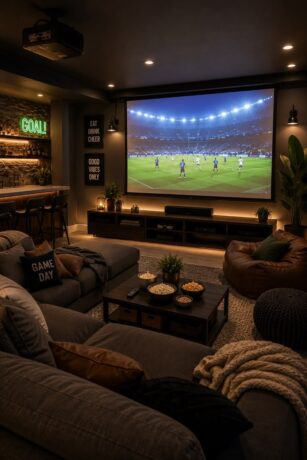
The most pristine form of the home theater idea: a room where there are no distracting light sources, design-specific acoustic treatments, dedicated seating, or a projection or large-format display system designed to give the greatest sense of “suspension.”
The perfect dedicated room should be painted in dark neutral colours which absorb light (not reflect it) and should have no or minimal windows (heavy blackout blinds over any windows present), and acoustic panels should control the reflection and standing wave.
Key components:
- A 4K laser projector with an acoustically transparent screen creates a truly movie-like experience, with a 120 or larger screen size. Acoustically transparent screens enable the use of center channel speakers behind the screen, not below or next to it, thus providing a much more realistic experience for the on-screen and dialogue sounds.
- Surround sound system: The standard of full cinematic sound in a dedicated surround sound room is currently 7.1.4 Dolby Atmos configuration, which consists of seven surround speakers, one subwoofer, four height channels (upwards firing speakers) and four ceiling channels (upwards firing speakers).
- Leather or velvet tiered recliner seating gives the authentic movie theatre experience. Depending on the room depth, either single row or two staggered rows can be used.
- Acoustic treatment: Bass traps in corners, absorption panels at primary reflection points (side walls and ceiling), diffusion panels at the rear wall provide a controlled acoustic environment to enable the maximum performance of the sound system.
The investment: This is the most costly item on this list, but it can offer you fantastic results. When this system is done properly, it is virtually an all commercial cinema setup.
2. Basement Conversion – Making the best of the space
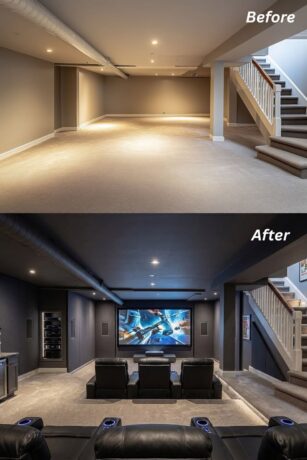
One of the ideal spaces to make your house entertainment equipped is your basement. They tend to be recessed and will help minimize noise from the outside world, will also be naturally warmer and cooler, and will not make it as difficult as above-grade rooms to create the “darkness of a darkened room” when using windows.
Additionally, the basement offers the freedom to build: acoustic panels can be installed into the wall structure itself, speaker wiring can be installed into the framing of the basement, and it will be easier to install the appropriate tiered flooring for elevated rear seating than it will be in a finished living area.
Design approach:
- Begin with sound isolation – Resilient channel or staggered stud assembly on common walls is effective in minimizing the transmission of sound through common walls to the rest of the house.
- For rooms where projection distance is limited use a high quality, fixed frame projector and screen or a large direct-view TV (85” or larger).
- Think about having a wet bar or a snack area next to one wall, because all the amenities—comfortable seating, excellent audio-visual equipment, and in-room refreshments—will make a family and friends entertainment center that they will all want to spend time in.
- The dimmable LED strip lights along the perimeter of the floor and behind the screen (bias lighting) provide atmosphere and allow easy changes of lighting mood.
Pro Tip: Even an unfinished basement can be part converted — with a vapor barrier and floating floor system over the concrete slab, proper ceiling joist insulation and drywall on the walls for an instant “finished basement.”
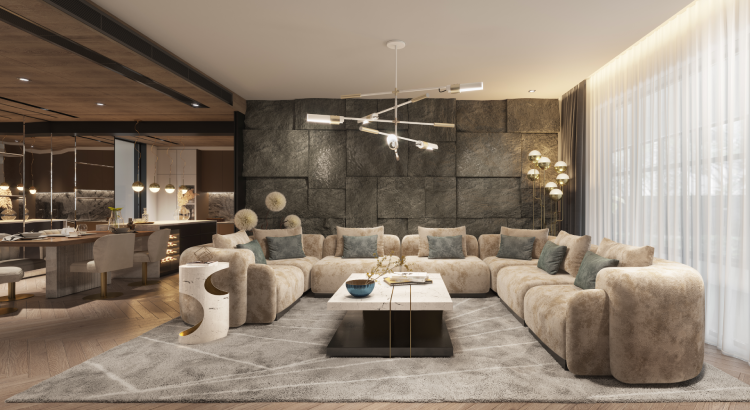
3. The Living Room Upgrade — Elegant Dual-Purpose Design
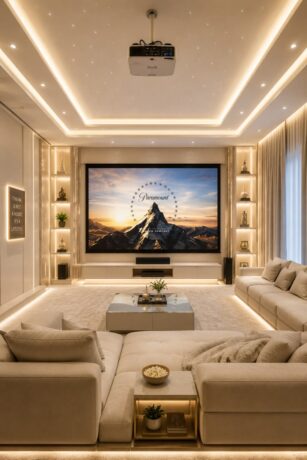
It is not possible to have a spare room or basement for entertainment for everyone. The renovation concept for the living room is based on this premise, and aims to create the optimal acoustical and visual environment in a room that also has other uses.
Here the biggest hurdle is the visual integration, where the equipment doesn’t seem to just fall into the living room, but rather it is a well-thought-out design decision.
The steps to making it work:
- When integrated correctly, the screen is the focal point of the room, and can be an 85-inch or larger OLED or QLED TV. The correct height – center of the screen at the seated eye level – and cables behind the wall, gives a very streamlined look.
- The sound: If you want better than TV speakers but not too much, then a great Dolby Atmos soundbar with a separate wireless subwoofer and surround satellites will do the trick without getting in the way (or obtrusive) with visual clutter. Instead, a pair of slim floor-standing speakers on either side of the TV set and another center channel speaker built into the TV set offers complete stereo separation without taking up a lot of space.
- Cable management/TV media storage: An engineered TV unit with hidden equipment storage and ventilation will help prevent a cluttered room with electronics.
Styling Tip: If you have LED strips behind the TV, they provide bias lighting and minimize eye fatigue while watching TV, which also enhances the contrast perception and brings the room’s ambiance to a more true-to-life level, even in normal use.
4. The Outdoor Cinema Setup — Seasonal Magic
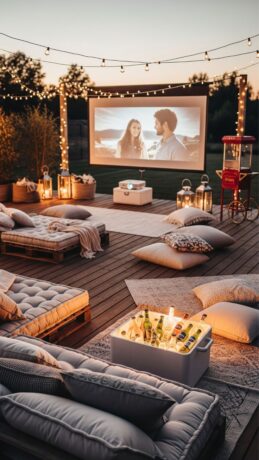
Watching a film under an open sky is something special — and not as bad as the makeshift sheet-and-projector versions of it imply if you’re equipped with the right technology.
An outdoor movie setup is an outdoor projector (or regular projector moved outdoors seasonally), an outdoor screen on an inflatable or frame and wireless Bluetooth or WiFi speakers set up to provide an acceptable amount of sound without having to install permanent outdoor cable runs.
The elements of outdoor cinema:
- Size of screen: You can go large outdoors that you would not be able to go as big in any other room. 150 inch (and 200 inch) inflatable screens are available and make for an extraordinary visual event.
- Brightness of the projector: A projector will be needed that is brighter than the ambient light conditions for outdoor viewing, but it is best to have one that is as dark as possible. The minimum number of lumens (for reasonable outdoor performance) is 3,000; for use in areas that are not completely dark, it is 5,000+ lumens.
- Outdoor floor cushions, low lying loungers or blanket/ pillow design on the lawn creates a feel of being really festive and special. This is not about doing what you see in film, it’s about making it all its own.
- Audio: Wireless speakers, at the level of the seating, and facing outwards towards the audience, deliver surprisingly good coverage. A compact portable subwoofer is added to complement the low frequencies, which give a film audio the fullness and presence.
Ideal for: Utilizing in warm weather for film nights, family events and social gatherings.
5. The Gaming-First Hybrid Setup
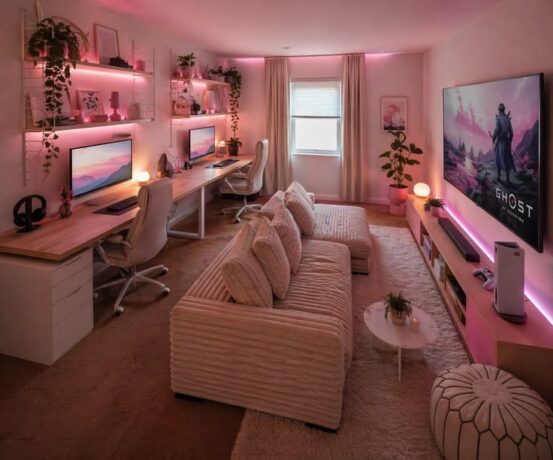
While some home entertainment rooms revolve around film, not all do. Whereas for gamers the focus is on different things such as reduced display delay, screen placement where they can sit closer while playing games and an audio system that performs well with precise forward and backward movement direction for competitive games and the immersion for movies.
The components of a home theater designed for use in a game-oriented environment are different than those that are used in a film-oriented home theater:
Display priorities:
- Both for titles and cinema, a large sized (77-inch or more) OLED screen possesses the minimum input lag, the highest contrast ratio and the most accurate handling of motion of any existing display technology.
- Move closer than film sets – in the gaming environment, being seated at 6 to 8 feet from a 77 inch screen is truly an immersive experience, albeit a different kind, but still very motivating.
Audio priorities:
- For competitive games, a gaming headset offers accurate positioning audio, while for social games and story-driven single-player games, a suitable surround set-up makes a huge difference.
- 5.1 channels and a responsive subwoofer (low group delay, tight bass performance) can also be used to play games and watch movies.
Room considerations:
- Switchable ambient lighting (Philips Hue or compatible smart lights, to be synchronised with the content on the displays) makes for a more immersive gaming experience.
- Extended sitting sessions are not enjoyable unless you have a dedicated gaming chair or ergonomic seating arrangement to avoid the fatigue that comes with prolonged sitting.
6. The Budget-Conscious Starter Setup
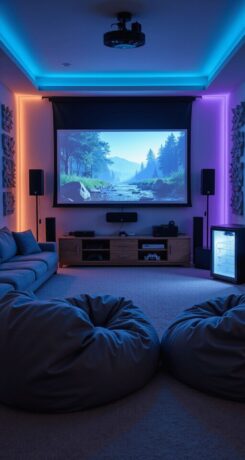
Anything luxurious is a desire — yet a truly great home entertainment experience is easily attainable on a truly modest budget. The trick is to know what parts of the program offer the highest experiential bang per buck.
There are three priorities for budgetary allocations:
- Screen size first: In actual viewer engagement, larger screen, lower resolution will be better than a smaller screen, higher resolution, every time. In most viewing environments, a 75-inch 4K budget TV will make a more powerful impact than a 55-inch premium TV.
- Subwoofer second: No listener will ever be able to tell the difference between a system without a dedicated subwoofer and one with a dedicated subwoofer. The quality of the whole sound system is boosted by a good budget subwoofer and a simple soundbar.
- Room setup third: The equipment is not required to be at an additional cost for setup third with speaker positioning, acoustic treatment with bookshelves and soft furnishings as well as proper screen mounting.
Setup which is truly budget friendly:
- Some of the mid-range TVs from the major manufacturers are 75-inch 4K TVs.
- Wireless Dolby Atmos soundbar with high-quality sound.
- Correct mounting of wall at correct eye level
- Dark day lightout curtains
- Adjust the light behind the TV so that it’s not harsh.
With careful design, this setup will provide a vast user experience that is well beyond its value.
7. The Smart Integrated Premium Setup
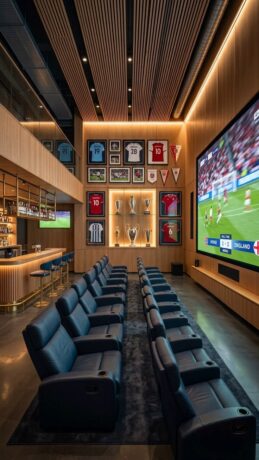
The smart integrated system is the most technologically advanced offering on this list; the home theater is integrated into a connected home ecosystem that lets the lighting, shading, temperature, audio, video and even seating be controlled from a single point — or automated via pre-set scenes.
With a touch (or voice) the room changes: motorized blackout shades close, lights switch to a warm amber setting, display comes on, surround system kicks on and room seating reclines. At the end of the film the mode is automatically switched back to normal.
The main elements of a smart integrated system:
- Control system: Savant, Control4 or Crestron are the professional solutions and Apple HomeKit or Google Home are more approachable solutions with real functionality.
- Motorized shading: Lutron Serena or other motorized shade options are available, and can be controlled by most of the major smart home platforms.
- Calibrated audio processor + display: The audio processor is ISF calibrated with a professional calibrated display to match reference standards and Audyssey (or Dirac Live system with room correction) is applied to the audio processor.
- Smart seating: Power recliners with USB charging, lighting & cup holders built into armrests round it up.
This is the arrangement that people will recall. It isn’t an entertainment system, it’s an experience that feels curated, easy and truly amazing.
The 4 pillars that make a great home theater
No matter how big or tiny your home theater is, no matter how much you can afford, these are the four essentials of a great home theater setup:
- Rule of thumb: optimal size (in inches, diagonal) of the display is 0.84 times the viewing distance (in inches). The best screen size for a 10 ft (120 in) distance is around 100 in.
- Bass management: When using a dedicated subwoofer or multiple subwoofers to manage low frequency content (under 80Hz) it can completely transform the audio quality and physical immersion.
- Light control: If there is any other light source that interferes with the display, it greatly affects the contrast and picture quality of the display. The best blackout treatments in the house are among the best investments that one can make with their home cinema.
- Seating comfort: If you’re not comfortable after 45 minutes, then no home entertainment system can live up to its promises. Support, cushioning and the recline angle that will not force the head forward during prolonged viewing are essential.
Conclusion
The right home theatre system doesn’t necessarily have to be expensive, it’s the one that absorbs you into the experience you’re viewing. It’s whether you’ve constructed a focused dark room setup with a 7.1.4 Atmos system, transformed a basement into a family entertainment center, upgraded a living room with an integrated smart system or created a clever budget configuration that beats its price tag, but you’re always looking for a space where great content becomes a really great experience.
Use what you have! Upgrade methodically. Focus on what is most noticeable first – screen size, subwoofer, light control and comfortable seating. And treat your time with great content in great space time, because the hours you spend watching great content in great space are great time spent.
The most commonly asked questions (FAQs)
Q1: What is the most important component in a home theater setup?
Overall, it’s the most significant element of the display in terms of the experience, more specifically the size as compared to the distance from the display. A large screen at an appropriate resolution will produce greater immersion than a small higher resolution screen at the same distance (assuming the viewing distance is the same). The second most effective audio improvement available is a good subwoofer, after screen size.
Q2: Is there a need for a separate room for a home theater?
Not at all. With the right equipment and setup strategy, a living room, basement, bedroom or even a garage space can be a real impressive home entertainment area. While more acoustic control and full light management can be achieved with the use of dedicated rooms, excellent results can be obtained in a dual purpose room.
Q3: Home cinema – which one is better: projector or TV?
All projectors have a larger size screen for a lower price per inch of the screen’s diagonal measurement (which is a very good advantage for dark rooms where the distance to the screen is acceptable). Large direct-view TVs (OLED or QLED) provide the best brightness in ambient-light conditions, lower input lag for gaming, and an easier installation option. This will depend on your favorite application, the distance from which you are viewing and the amount of light in your room.
Q4:If you’re building a home theater room, how crucial is acoustic treatment?
Of great significance — but often unrecognized. Untreated rooms have the following characteristics: bass buildup in corners, parallel wall flutter echo, early reflections that cause a loss of the stereo image and dialogue clarity. The performance of the sound system is obviously improved even by the relatively simple acoustic treatment (bass traps in corners, a few absorption panels at primary reflection points, a rug on hard floors).
Q5: What is a reasonable budget for a novice/beginner home theater?
If you buy a quality 4K TV (75-inch), a matching quality Dolby Atmos soundbar with a wireless subwoofer, mount it correctly, and get some blackout curtains, then you can put a satisfying baby crib together for $800 to $1,500 based on your brand and timing. A good mid-range system consisting of an amplifier and a separate speaker, an adequate 85-inch display and seating will cost $3,000 to $8,000. The cost of dedicated rooms, that feature projection screens and surround sound setups, can range from $10,000 to $50,000 or higher, depending upon the scope and quality of the components.